
Module 1: Understanding Sales and the Zambian Customer
Lesson 1.1: What Is Selling and Why People Buy
What You Will Learn
By the end of this lesson, you will be able to explain what selling really is, identify the main reasons people buy, and describe how a simple sales conversation moves a stranger from "just looking" to "I will take it."
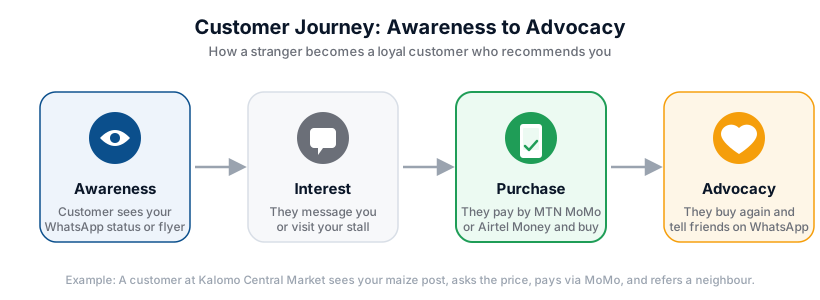
What Is Selling?
Selling is not tricking people into buying things they do not need. Selling is helping someone solve a problem or satisfy a desire in exchange for money. A good seller listens first, understands what the customer wants, and then shows how a product or service can deliver that result. When done well, both the customer and the seller walk away happy.
Think about the last time you bought something. Maybe it was a new pair of chitenge materials, a bag of mealie-meal, or a phone charger. You did not buy because the seller shouted the loudest. You bought because the item solved a problem for you: you needed food, you wanted to look smart, or your charger had stopped working. Selling starts with understanding that problem.
Why Do People Buy?
People buy for emotional reasons and justify the decision with logic. The six most common reasons are:
- Need: They have a problem that must be solved now. A farmer needs seed before planting season. A parent needs school shoes in December.
- Want: They desire something that makes life nicer. A salon visit, a new hairstyle, or a cold Fanta on a hot afternoon.
- Fear: They want to avoid loss or danger. A family buys a gas stove because load-shedding makes electric cooking unreliable.
- Greed or gain: They believe the purchase will save or make money. A shopkeeper buys stock in bulk because the unit price is lower.
- Pride or status: They want to look good in front of others. A young professional buys a smart outfit for church or a job interview.
- Convenience: They want to save time or effort. A busy civil servant buys ready-cooked lunch instead of cooking at home.
The best sellers figure out which reason is driving the customer and speak directly to it. If a mother is buying school shoes because she fears her child will be teased, talking about durability alone will miss the mark. You must also say, "These shoes look smart and will keep your child comfortable all term."
The Sales Conversation in Four Steps
Every sale follows a simple path, whether it happens at Soweto Market, in a WhatsApp chat, or over the phone.
- Greet and build trust: Smile, greet the person by name if you know it, and show you are ready to help. A warm "Muli shani?" or "Good morning, how can I help you today?" opens the door.
- Ask questions: Find out what they need. "Are you looking for something for yourself or for the house?" "What size does your child wear?" "When do you need it by?"
- Present the solution: Show the product and explain the benefit. Do not just say "This is K120." Say "This blanket is warm, it is the right size for a double bed, and the colour will not fade quickly."
- Ask for the sale: Many sellers do all the work and then forget to close. Say "Shall I wrap it for you?" "Would you like to pay with MoMo or cash?" or "How many would you like?"
Try It Yourself
- Pick an item you sell or could sell.
- Write down one problem it solves and one desire it satisfies.
- Practice greeting a customer, asking two questions, presenting the benefit, and closing with one clear sentence.
- Record yourself on your phone or practice with a friend.
- Ask your practice partner which part felt most natural and which part felt forced.
Key Terms
- Selling: Helping a customer solve a problem or satisfy a desire in exchange for payment.
- Customer need: A problem or requirement that drives a purchase decision.
- Benefit: The positive result a customer gets from using a product or service.
- Close the sale: The moment you ask the customer to make a decision or complete the purchase.
- Value: The balance between what the customer pays and what they receive.
Summary
Selling is a service, not a battle. People buy to solve problems, satisfy desires, avoid fears, or gain convenience. A simple four-step conversation — greet, question, present, close — turns a stranger into a customer. Master these basics and every other sales skill becomes easier.