
Module 1: The Role of a Secretary and Office Professional
Lesson 1.1: What Secretarial Work Looks Like Today
What You Will Learn
By the end of this lesson, you will be able to describe what a secretary or office professional does in a modern Zambian workplace, identify the different organisations that employ secretaries, and explain why clear document flow matters for any office.
What Is a Secretary Today?
A secretary is no longer only a person who types letters and answers the phone. In today\'s offices, a secretary is an organiser, a communicator, a record keeper and often the first point of contact for visitors and callers. The title may be Receptionist, Office Assistant, Administrative Assistant, Personal Assistant or Executive Secretary, but the core work is the same: keep the office running smoothly so that managers and staff can focus on their main jobs.
In a Zambian context, secretaries work in government ministries in Lusaka, district council offices, NGO coordination desks, bank branches, school administration blocks, clinics and private companies. A secretary at the Ministry of Education might handle letters from schools, schedule meetings for the provincial education officer and maintain confidential staff files. A secretary at a bank in Kitwe might process customer correspondence, prepare meeting rooms and control office stationery. A secretary at a rural clinic might book patient appointments, keep stock cards for medicines and take minutes at clinic-in-charge meetings.
Common Daily Tasks
Although every office is different, most secretaries perform a similar set of tasks each day. These include receiving and directing visitors, answering telephone calls, handling incoming and outgoing mail, scheduling appointments, preparing meeting documents, taking minutes, filing records, ordering stationery, making travel arrangements, and using computers to produce letters, reports and spreadsheets.
The order of these tasks changes constantly. A good secretary knows how to prioritise. If the District Commissioner is expecting an urgent letter and a visitor is waiting at reception, the secretary must decide which task needs attention first. This ability to manage time and stay calm under pressure is one of the most valuable skills in the job.
Where the Secretary Fits in the Office
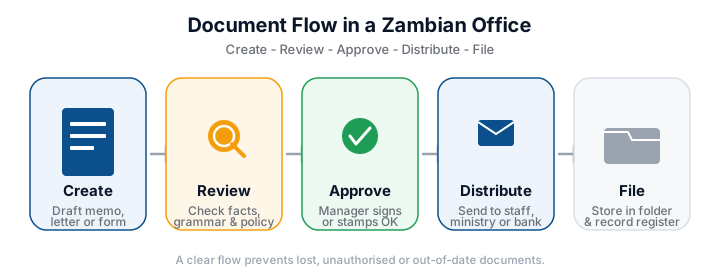
The secretary usually sits between the manager and the rest of the staff, customers and outside organisations. Information flows through the secretary\'s desk. Letters arrive, are opened, sorted and passed to the right person. Decisions made in meetings are recorded by the secretary and turned into action lists. Appointments are booked through the secretary\'s diary. Because of this central position, the secretary must be reliable, discreet and highly organised.
Think of the secretary as the office engine. When the engine is well maintained, the whole vehicle moves. When it breaks down, delays and confusion follow everywhere.
Try It Yourself
- Visit or imagine a small office in your town, such as a clinic, bank or school.
- List ten tasks you think a secretary does there in one day.
- Circle the three tasks that you believe are most important for keeping the office running.
- Write one sentence explaining why the secretary is the "information hub" of that office.
Key Terms
- Secretary: An office professional who handles correspondence, records, appointments and communication.
- Administrative assistant: A staff member who supports managers by organising tasks, files and schedules.
- Information hub: The central point through which messages, documents and instructions pass.
- Prioritise: To decide which tasks are most urgent and important.
- Discretion: The ability to keep information private and use good judgement.
Summary
Secretarial work in Zambia is diverse and essential. Secretaries keep information moving, support managers, serve visitors and callers, and maintain the records that allow organisations to function legally and efficiently.