
Module 1: Introduction to Purchasing and Supply in Zambia
Lesson 1.1: What Purchasing & Supply Means for Organisations
What You Will Learn
By the end of this lesson, you will be able to explain what purchasing and supply means for an organisation, describe the five main steps of the procurement cycle, and give examples of how this works in Zambian schools, clinics, farms and government departments.
What Is Purchasing and Supply?
Purchasing and supply is the professional work of buying the goods and services an organisation needs, at the right quality, in the right quantity, at the right price, from the right supplier, and delivered at the right time. It is not simply walking to a shop with cash. It includes planning, choosing suppliers, placing orders, receiving goods, paying invoices, and keeping records that can be checked later.
Every organisation in Zambia depends on purchasing and supply. A Ministry of Health clinic needs gloves, syringes and malaria test kits. A Ministry of Education school needs chalk, textbooks and desks. A farm needs seed, fertiliser and fuel. A small business in Kalomo needs stock, packaging and internet data. When purchasing is done well, money is saved, services improve and fraud is reduced.
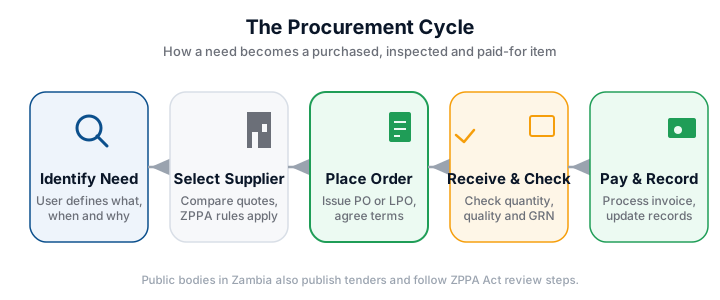
The Procurement Cycle in Everyday Language
The diagram above shows the five stages of a typical procurement cycle. Identify need means someone in the organisation realises that something is required. A school bursar may notice that there are only twenty exercise books left in the store. A nurse may see that the clinic is running out of gloves. Select supplier means finding someone who can provide the item at a fair price and good quality. In the public sector this must follow Zambia Public Procurement Authority (ZPPA) rules.
Place order is the moment the organisation confirms what it wants. This usually happens through a purchase order or local purchase order (LPO). Receive and inspect means checking that what arrived matches what was ordered. If 100 boxes of chalk were ordered but only 80 arrive, the receiving officer must record the shortage. Finally, pay and record means processing the supplier's invoice, making payment through bank transfer or mobile money, and filing all documents for the audit.
Why Purchasing Matters in Zambia
Zambia is a landlocked country. Many goods must travel long distances by road from Dar es Salaam in Tanzania or Beira in Mozambique. Transport costs, fuel prices, border delays and currency changes all affect the final price of the items an organisation buys. A purchasing officer who understands these factors can save an organisation thousands of Kwacha every year.
Public money must also be used transparently. The ZPPA sets rules so that government contracts are awarded fairly. Ministries, councils and public schools must advertise tenders above certain thresholds, evaluate bids openly, and keep complete files. This protects public funds and builds trust.
Try It Yourself
- Think of one item your school, workplace or community organisation bought recently.
- Write down who identified the need, who chose the supplier, and how payment was made.
- Draw the five-stage procurement cycle for that one purchase.
- List one risk that could have gone wrong at each stage.
Key Terms
- Purchasing: The process of buying goods and services for an organisation.
- Supply: The flow of goods and services from suppliers to the end user.
- Procurement cycle: The repeating steps of identifying need, selecting supplier, placing order, receiving and inspecting, and paying.
- Local Purchase Order (LPO): A document used to confirm a purchase from a supplier.
- ZPPA: Zambia Public Procurement Authority, the body that regulates public procurement.
Summary
Purchasing and supply is much more than shopping. It is a structured process that helps organisations get what they need while protecting money and reputation. Understanding the procurement cycle is the first step towards becoming a professional buyer in Zambia.