
Module 1: What Is Monitoring & Evaluation and Why Projects Need It
Lesson 1.1: The Difference Between Monitoring and Evaluation
What You Will Learn
By the end of this lesson, you will be able to explain the difference between monitoring and evaluation in plain language, describe when each is used, and give examples from real projects in Zambia.
What Is Monitoring?
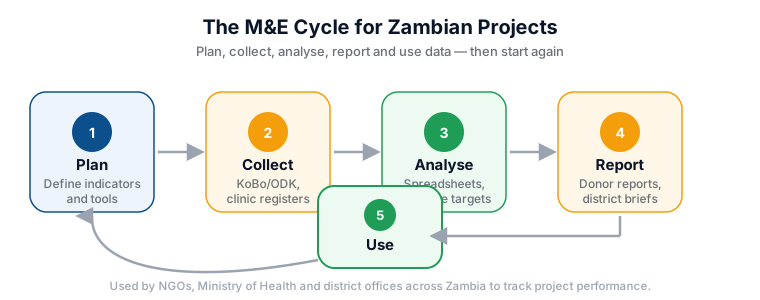
Monitoring is the regular collection and review of information about a project while it is running. It answers the question, "Are we doing what we said we would do, on time and with the resources we planned?" Monitoring is like checking the speedometer and fuel gauge when you are driving from Kalomo to Lusaka. You do it continuously so you can correct course before you run out of fuel or miss a turn.
For example, imagine an NGO is distributing mosquito nets in Choma District. Monitoring would track how many nets were distributed each week, how many villages were reached, how much money was spent, and whether the distribution followed the agreed schedule. These numbers are usually collected from registers, tally sheets, or mobile forms and checked against monthly targets.
What Is Evaluation?
Evaluation is a deeper assessment that asks, "Is the project working? Is it making a difference? And is it worth the money and effort?" Evaluations usually happen at specific moments — at the middle or end of a project, or after a pilot phase — and they look at outcomes and impact, not just activities.
Using the same mosquito net example, an evaluation would ask whether the nets actually reduced malaria cases in children under five, whether families used the nets correctly, and whether the project reached the poorest households. Evaluations often compare data before and after the project, or compare villages that received nets with villages that did not.
The Key Differences
| Monitoring | Evaluation |
|---|---|
| Asks "Are we on track?" | Asks "Did we make a difference?" |
| Happens regularly (daily, weekly, monthly) | Happens at specific points (midline, endline) |
| Focuses on activities, outputs and spending | Focuses on outcomes, impact and value for money |
| Uses simple tools like registers and checklists | Uses surveys, interviews, comparisons and analysis |
| Managed by project staff | Often involves external evaluators for objectivity |
Why Both Are Needed
Monitoring without evaluation can keep a project busy without knowing whether it is changing lives. Evaluation without monitoring can be a one-off judgment that misses problems while the project is still running. Strong projects in Zambia combine both: monitoring keeps things moving, and evaluation proves whether the investment was worthwhile.
Try It Yourself
- Think of a project you know (a school, a clinic, an NGO programme, or a TEVETA training).
- List three pieces of information you would monitor every month.
- List two questions you would ask in an end-of-project evaluation.
- Explain the difference to a colleague in two sentences.
Key Terms
- Monitoring: Regular tracking of project activities, outputs and resources against a plan.
- Evaluation: Systematic assessment of a project's results, effectiveness and impact.
- Output: A direct product or service produced by a project (for example, 500 people trained).
- Outcome: A short- to medium-term change resulting from outputs (for example, farmers applying new techniques).
- Impact: Long-term change in people's lives or conditions (for example, reduced malaria deaths).
Summary
Monitoring tells you whether a project is being implemented as planned. Evaluation tells you whether the project is achieving its intended results. Both are essential for accountable, learning-oriented organisations in Zambia.