
Module 1: Setting Up Your Online Shop with WhatsApp and Facebook
Lesson 1.1: Choosing What to Sell Online
What You Will Learn
By the end of this lesson, you will be able to decide which products are suitable for selling online, calculate a healthy profit margin, and explain why some local Zambian products have an advantage in online markets.
What Sells Well Online?
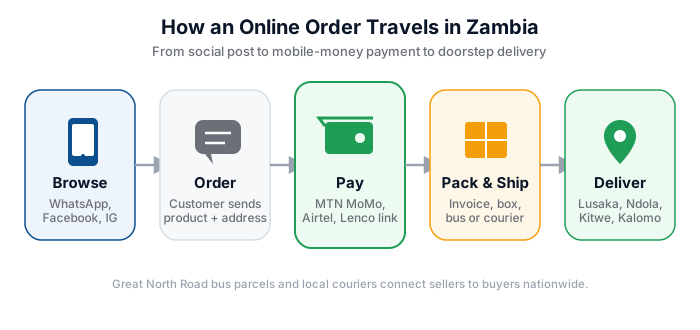
Not every product is a good fit for online selling. The best online products are easy to photograph, light enough to deliver at a reasonable cost, and solve a clear problem for the buyer. In Zambia, products that connect to our culture, natural resources, and daily needs often perform well because local buyers understand them and diaspora customers miss them.
Think about items you already see on WhatsApp statuses and Facebook pages: pure honey from Northwestern Province, handmade chitenge bags and wraps, beaded jewellery, carved wooden crafts, dried mushrooms and kapenta, organic groundnut oil, fresh farm vegetables, and even custom birthday cakes. These products work because they are visual, have a story, and can be shipped or delivered without too much damage.
Digital Products vs Physical Products
Physical products are items you can touch and must deliver. They need packaging, a delivery plan, and stock management. A physical product business is great when you enjoy making or sourcing things, but you must remember that every order costs money for materials, packaging, and transport.
Digital products are files or services delivered online. Examples include printable planner templates, wedding invitation designs, social media graphics, resume templates, or online tutoring sessions. Digital products have almost zero delivery cost and can be sold many times, but you need skills that customers are willing to pay for. A student in Lusaka who designs event flyers on Canva can sell the same design to ten customers with no extra printing cost.
Calculating Profit Before You Start
Before you list a product, do the numbers. Suppose you want to sell a 500g jar of pure honey.
- Cost to buy or produce the honey: K35
- Glass jar and label: K8
- Packaging for delivery: K5
- Mobile money withdrawal fee (about 2%): K2
- Bus parcel delivery to Lusaka: K25
Your total cost is K75. If you sell the jar for K120, your profit is K45 per jar, which is a 60% markup on cost. That is healthy for a small online business. If you sell for K85, your profit is only K10 and one refund or broken jar wipes out several sales. Always price for profit, not just to be cheap.
The Local Advantage
Zambian sellers have advantages that big foreign websites cannot copy easily. You can offer same-day delivery in your town, personal WhatsApp service, mobile money payment, and culturally specific products. A customer in Ndola who wants chitenge fabric for a kitchen party would rather buy from a seller who understands the occasion than from a generic overseas site.
Try It Yourself
- List five products you could sell online. Mark each as physical or digital.
- For your best idea, write down the cost of making or buying one unit.
- Add packaging, payment fees, and estimated delivery costs.
- Choose a selling price and calculate your profit per unit.
- Ask two friends or family members whether they would buy it at that price.
Key Terms
- Profit margin: The percentage of the selling price that is profit after all costs are paid.
- Digital product: A product delivered electronically, such as a file, design, or online service.
- Physical product: A tangible item that must be packed and delivered.
- Markup: The amount added to the cost price to set the selling price.
- Target market: The specific group of people most likely to buy your product.
Summary
Choosing the right product is the foundation of online selling success. Look for items that photograph well, ship safely, solve a real need, and leave you with enough profit after all costs. Start with one or two products, get them right, then expand.